Showing posts with label stephen hopkins. Show all posts

Tuesday, November 27, 2012

We've been here before


This would have been up yesterday, but I spent the entire day driving back from Chicago on a MegaBus which said it had WiFi but definitely did not have WiFi.
Michigan 21 - Ohio 26
Daniel Brenner | AnnArbor.com

And so it finally, unmercifully, comes to an end. After two years of miserable playcalling, shoddy quarterback play, and more turnovers than you can shake a stick at, Michigan can finally say goodbye to Denard Robinson, he going out exactly the way he played: turning the ball over on a crucial drive. Al Borges will take the blame for the playcalling in this game, but he's not the one giving the ball away on three second-half drives. He's not the dual-threat senior quarterback that in his third year as a starter doesn't know how to protect the ball. But he is the one that's telling the Buckeyes exactly what's going to happen just by the personnel on the field.

I can understand Borges' thinking on playcalls in this game. I spent most of the weekend playing darts at various bars around Chicago. When you're an amateur playing another amateur in Cricket, there's a very specific strategy you should employ to ensure the best possible results: aim for the bullseye. The logic shows that with natural variance and drift on your shots, you're just a likely to hit one of the six other numbers you're supposed to, reducing rounds that you don't mark at all and optimizing your ability to get lucky. I don't throw this way despite my status as Amateur. If you're relying on noise, you'll never truly get better; push yourself to do the hard stuff and eventually it'll come naturally.

Unfortunately for Michigan, Denard and Devin on the field at the same time is not noise as Borges likely thinks of it (trick plays that are just as likely to get you zero yards as 60). Against OSU, Borges was throwing at the triple 20 over and over again and kept hitting triple 1. If you can hit your spot every time (say, running under-center power on third and three), there's no problem attacking that spot repeatedly, but Borges needs to accept that the status of his offensive line and running backs is not such that you can confidently rely on. Take the yards where you can get them and play your best strategy.

It was hard to watch this game and see Michigan's players just continually beaten, both physically and mentally. Stephen Hopkins was abhorrent and played perhaps the worst game I've ever seen from a fullback. The offensive line was tossed around like ragdolls. Michigan's corners completely unable to guard anyone and JT Floyd getting turned around like he did against Penn State two years ago. At times, this was men against boys, something I had thought was extinct after how well the team had played the last two years.

So now there's a bowl game left, but it feels like a punishment more than a reward. I don't want to watch this football team play another game. I'm tired of seeing the offensive line lost and unfit to play with the elite. I'm tired of Denard Robinson. I'm tired of JT Floyd. I'm tired of not having a viable running back on the roster. We're officially ushering a new era after this season: Borges will get his passing-capable QB, Hoke gets his offensive line of fridges with feet, the secondary rids itself of its most inadequate piece, and the more time that passes, the further we get from Rich Rodriguez's recruiting disasters.

2013 will hold better things for a Michigan team that was probably a lot better than its record showed. Having even a remedial offense coupled with an all-world defense is the way that LSU and Notre Dame and Alabama have won national championships in the recent past. They were bolstered by an excellent running game, the likes of which Michigan can't match, but perhaps the new offensive linemen will be a revelation. I'm excited for the future of this team, but I'm tired of where they've stalled this season.

Melanie Maxwell | AnnArbor.com
Bullets

  • Lawdy lord, the defense. This defense rules. I cannot wait to see them in the future. They bend-don't-break'ed an offense that if you're bending, you're typically breaking. Jake Ryan's ability to stay with Braxton Miller's jukes in space is a revelation. Have fun on Sunday's sweet prince.
  • Howeva, the defensive line was struggling to hold up against double teams the way they had in previous weeks. That allowed OSU offensive linemen to release to the second level and seal off Michigan's linebackers. That ended poorly for Michigan and well for Carlos Hyde.
  • The Wolverine defense will get way better without JT Floyd, though. His weakness as a cover corner significantly limits Mattison's schemes. Next year we should see the defense take another step up when Mattison feels confident leaving Countess and Taylor out on islands.
  • No seriously, Stephen Hopkins was horrible. How he isn't smart enough to play fullback, I'll never know.
  • Devin finally came back down to earth. One of the main reasons is that the OSU defensive line play gap-sound and didn't allow him to break the pocket much. Gardner had no where to run on drop backs, something that they clearly gameplanned for.
  • Speaking of stopping QB scrambles: I hate rushing only two defensive linemen on third-and-long. That never seems to work. It allows the opposing quarterbacks to sit in the pocket and receivers to find holes in the zone defense which always develop with enough time. I think I remember Michigan doing this twice and neither time did it provide any results. Mattison, stick with your gut: blitz from one side of the field and force a scramble into your zone defenders like you've done all year.

Tuesday, September 11, 2012

Missed blocks vs. Air Force


After Saturday's game, everyone is in panic mode concerning the offensive line, myself included:
The offensive line just can't get any push upfield, which, against Air Force's undersized defensive front is a major red flag. It could be that the line is still trying to gel, but it seemed like Michigan was running power blocking techniques most of the game, which would negate many of the double teams that could cause confusion on the line.
Rewatching the game, there are a lot of different plays where Michigan's offensive line just gets beat, but there were also plays that it's clear the restructured offensive line just needs more time to play together.

On the first play of Michigan's second drive, the team comes out in a three-wide set with stacked receivers to Denard's right. Fitz Toussaint and Stephen Hopkins are flanking Denard in the backfield. The playcall is a QB lead draw.


When the ball is snapped, center Elliott Mealer gets immediately into the Air Force nose tackle. Though he'll end up being at least partially at fault for the result of this play, how quickly he gets off the ball is impressive.


After pushing the nose tackle toward Patrick Omameh, Mealer begins to release to the second level to block the Air Force linebackers. Unfortunately, he identifies the wrong linebacker to block...


....and the inside 'backer has a step on Mealer.


Not only has Mealer been beaten by the inside linebacker, but next to him, Omameh is unable to block the nose tackle (highlighted).


Air Force now has two tacklers behind the offensive line and only Hopkins available to block them.


Denard has to juke the first defender and is eventually wrapped up behind the line of scrimmage.


Video

The Takeaway
A few things here. First, I believe this is a man-blocking scheme with a double team at the point of attack. I think Mealer is right to release to the second level so quickly--Omameh doesn't look caught off guard by the double team, but he does get beat on it--but he still fails to identify the correct linebacker to block. Regardless of who is ultimately at fault, this probably doesn't happen with David Molk at center.

The good news is that the biggest problem with this play appears to be communication/knowing the structure of the play rather than pure performance, though neither Mealer and Omameh come off looking good here. With another two weeks of practice and a cupcake game before Michigan faces Notre Dame, the offensive line will have plenty of time to watch film and get this sorted out.

The other think to watch, which isn't pertinent to the play, is Jeremy Gallon at the bottom of the screen, who bends out for a screen pass that isn't thrown. Michigan showed this motion a lot in the first two weeks but only threw the screen twice (both against Alabama, both for 8-yard gains). The Air Force defenders don't look at Gallon on this play, despite him waiting in the flat with a blocker in front of him. My hope is that eventually, this becomes a read for Denard and isn't just smoke and mirrors. If Borges is trying to use this formation/motion to draw defenders and keep the defense honest, opposing defenses actually have to react to it or Michigan will be wasting blockers who could be downfield.

Tuesday, September 4, 2012

Shucking Schofield pt. 2


Shucking Schofield pt. 1

Earlier, we saw Michael Schofield unable to hold up a block against Alabama's weakside defensive end on a Thomas Rawls run. The play ended as you might expect (sort of; it technically ended as a holding penalty): Rawls was pushed into the backfield and taken down by Bama's weakside linebacker. On this play, Schofield (right tackle; lineman at the bottom of the screen on this play) just fails to make contact with the defensive end, allowing him a clear path into the backfield.

Michigan is lined up in an I-formation, two-WR set with Vincent Smith and Stephen Hopkins in the backfield. Michigan will run a traditional power-I run to the strongside of the field (top of the screen). Alabama is in its traditional 3-4 defense.


As the ball is snapped, Denard steps away form center and Patrick Omameh (#65) pulls behind him. Schofield is charged with filling the hole that Omameh just vacated and not allowing Alabama's defensive end (#49) to get inside.


You can see Schofield will not accomplish this task.


Schofield (#75) doesn't even make contact with the defensive end until he's two steps behind the line of scrimmage. Denard hasn't even handed the ball off to Vincent Smith yet, who is looking to follow Omameh and Hopkins upfield.


When Smith finally does get the ball, he has to juke immediately because the Alabama WDE is already in his face. You can see the weakside linebacker (#42) flowing downhill as well, but if this were blocked correctly, that linebacker wouldn't be much of a factor until a few yards downfield.


Schofield, who never got square to his man, is now chasing Bama's defensive end who is wrapping up Smith in the backfield. Omameh and Hopkins are both in good position to block downfield and allow Smith to get to the edge of the line for a good gain.


Because Smith is not superhuman, the play ends with Schofield (probably) apologizing to Smith as he picks him up off the ground.


Video

Takeaway
So those are two of the more egregious examples from the game, but they paint an unflattering picture of Schofield's run blocking capabilities. As I mentioned earlier, moving to the tackle position after playing guard last year is a big change, and this was the worst possible matchup to try out a new tackle. But keep an eye on whether or not he can adequately get to defensive ends and hold up blocks on runs to his side of the field. If this team becomes left-handed, that's just one more limitation that the offense has that perceptive defensive coordinators will attack.

Tuesday, August 21, 2012

What to expect: Running Backs 2012


Previously: Quarterbacks


Projected Starter: Fitzgerald Toussaint
After his 1,000 yard season last year, everyone knew Fitz Toussaint was Michigan's running back in 2012, the first established starter since Mike Hart left in 2007. Unfortunately, Fitz went and got himself a DUI and now his status with the team (in reality, just for the first few games) is in question. The chances are he misses the opener against Alabama or at least the first half of the game, depending on Hoke's disciplinary decisions, but we'll go forward assuming Fitz will retain his starting role once he's fully reinstated to the team.

Fitz didn't really break out until the Purdue game last year after he was given only two carries the week prior against Michigan State. He turned in solid performances against Western Michigan, Minnesota, and San Diego State early in the year, but none of those defenses showed much resistance; Fitz's performances could be written off as promising games against sub-par competition. After the MSU debacle, Fitz closed the regular season with 678 yards on 112 carries (6.05 yards/carry) until running into the Virginia Tech defense in the bowl game (30 yards on 13 carries).

Fitz has all of the traits you could want in a primary back: good vision, strong cuts, the ability to make people miss, ball security, and the strength to push the pile forward. Though not the workhorse that Mike Hart was, Fitz is a more complete back, and paired with Denard in the backfield, he presents a pick-your-poison proposition for defenses. Because opponents didn't want to risk Denard carrying the ball, that resulted in a lot of set-up blocking and open lanes for Fitz last year.
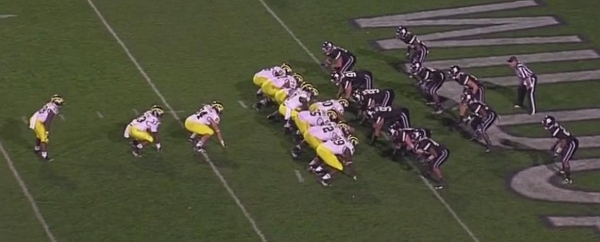
Barring a long suspension, Fitz should continue down the road he ended last season on: 5.5 to 6 yards/carry throughout the year and 15-20 carries a game. Even if he misses a game or two due to suspension, Fitz will likely surpass 1,000 yards this year, but won't get much higher than that.

The Backups: Vincent Smith, Thomas Rawls
With Fitz likely out for some or all of the Alabama game, the rushing load will fall on senior Vincent Smith and sophomore Thomas Rawls.

Preposterous though this may sound, Smith is probably the X-factor against Alabama if Fitz can't play--and probably even if he can. Though Fitz has proven to be a great ball carrier, Smith brings something to the table that no other back on Michigan's roster can: the ability to catch balls out of the backfield. Alabama's defensive line is going to nullify the advantage Michigan's offensive line will have against most teams, so the ability to keep the defense honest and account for a scat back coming out of the backfield could be valuable.

People have underrated Smith for the last year because of Toussaint's performances, but Smith was a dangerous back both carrying the ball and catching it under Rodriguez. Because of the Denardness of the 2010 offense, however, Smith has only garnered more than 15 carries twice in his career: against Purdue in 2010 and Delaware State in 2009. Smith is an exceptional blocker, but he can also make people miss in a phone booth. His ability to flex out as a slot receiver, catch balls from the backfield, and underrated running abilities make him a serious threat against teams (namely Alabama, the only team that he'll get significant touches against).

Next off the bench is Thomas Rawls. After the spring game, most spectators were convinced that Rawls is the future, but this won't be his year. My reaction following the spring game:
Thomas Rawls wins the annual Spring Game award for Most Impressive Player Likely to Spend the Season on the Bench. Rawls is a power runner that showed good vision and an ability to get upfield. This year still belongs to Fitz Toussaint, though. Rawls will be a good option when Toussaint needs a breather, but he doesn't offer much that Fitz doesn't already bring to the table. The biggest concern with Rawls isn't even about his play: I'm worried the coaches will try and revive the I-formation running game behind Rawls' shoulder pads. As we saw once again in the spring game, this team is ill-equipped to run from the I formation.
Those I-formation fears will be diminished next year when the Shane Morris show comes to town and the team plays from under center more, but this year, any I-formation running is conceding defeat. Rawls will be the short yardage back this year (with occasional appearances by bowling ball fumbleback Stephen Hopkins) but won't get more than 5 carries against any team that's not an early-season cupcake or late-season blowout. While promising, Rawls is still unproven, and though his spring game performance was impressive, it's still just a spring game.

The rest of the guys on the roster are just that: on the roster. The incoming freshmen (Dennis Norfleet and Drake Johnson) will spend the season on the bench, and redshirt freshman Justice Hayes is buried behind a bunch of competent-to-great backs already. Hayes might get some burn against Air Force and UMass, but otherwise, he'll spend the season riding the pine unless things go terrible wrong.

Tuesday, December 6, 2011

Long Denard TD vs. Ohio


Remember that time you beat Ohio? That was awesome.

So yeah, Michigan beat Ohio and that ruled. But they also did some things during the game that they hadn't showed throughout the season, the most effective of which was a zone read by Denard and Co. that MGoBlog long ago coined the inverted veer. Though Brian acknowledges that it isn't a veer at all, I'm not really sure what to call it. Given the pulling guard (as we'll see), maybe inverted power zone? I don't know, that sounds wordy. Maybe will stick with inverted veer. In any case...

Michigan comes out in a three-wide (twins to the top of the screen), two-back set. Ohio State is in a 4-3 under (hey!). Before the snap, you can see a blitz coming from the weakside cornerback (bottom of the screen). He'll attempt to time the snap but jumps a little early.


As the ball is snapped, Michigan's offensive line begins to zone block to the right. Patrick Omameh will pull across to the weakside of the formation. Ohio State's defensive line is slanting to the strongside, so Omameh gets caught up in the wash a little bit. His pull isn't clean. Fullback Stephen Hopkins is heading upfield to block the blitzing cornerback.


At the mesh point, I'm not really sure who Denard is reading. He is either reading the middle or weakside linebacker. Omameh unearths himself from the offensive line and continues to pull.


As Fitz Toussaint comes out of the mesh point, Denard pulls the ball, but I'm not sure why. If he's reading the middle linebacker (#6 in the middle of the screen), he should hand the ball off, but I'm not sure that's who he's reading. If he's reading the weakside linebacker (just below #6), I suppose he should pull the ball because he's further outside (?). Regardless, Denard pulls the ball.


Omameh pulls across the formation to block the weakside linebacker leaving Denard in space against the middle linebacker. This goes about as expected...


...Denarded


Denard bounces outside behind Omameh and gets to the sideline for a touchdown.


Lesson: Denard is better than you. Probably. Despite the outcome, I'm not sure if he made the proper read here. With Omameh pulling to block the weakside linebacker, it seems like Denard is reading the middle linebacker who diagnoses the play and is in position to make a tackle. But then Denard Denards him and runs for a touchdown. Regardless, Michigan didn't use this play all year until Borges unleashed it against Ohio State. There frankly weren't many new plays that the team showed on either side of the ball against the Buckeyes but they few that were deployed (this one specifically) were wildly effective.

Anyone with any insight into what Denard's read is here would be appreciated.

Wednesday, November 23, 2011

Nebraska's scrape exchange


Against Michigan, Nebraska used the scrape exchange defensive playcall to defend Michigan's zone read. We saw Rodriguez toy with countering this a few times, usually using a pulling H-back to block the unblocked defensive end and the weakside tackle to block the scraping linebacker. Borges has been using more two-back sets to the same effect, one time busting Fitz Toussaint for a 10-yard gain. What's really interesting to me on this play is what the unblocked Nebraska defensive end does.

Michigan is in a basic two-back set with three wide receivers. Toussaint is to Denard's left and Stephen Hopkins is to Denard's right. Nebraska is in a nickel formation.


As the ball is snapped, the weakside defensive end is left unblocked (bottom of the screen).


Despite being unblocked, the weakside defensive end actually grabs on to Taylor Lewan (you can actually see his arm grabbing the side of Lewan) and restricts him from getting to the second level to block a linebacker. This also creates a log jam on the strongside of the field. Hopkins is running across the formation, to kick out any defender that that might crash down on the handoff.


At the mesh point, Lewan, who is being held by the defensive end, decides to block him and push him downfield. The weakside Nebraska linebacker has scraped over the top of the play and is playing contain on Denard.


Denard properly hands the ball off. However, Toussaint is running into a mass of bodies, in large part due to the Nebraska defensive end who engaged Lewan. The key here is Hopkins who is still pulling across the formation and going to engage the weakside linebacker that forced Denard to hand the ball off.


Hopkins engages and seals the linebacker to the outside. Lewan is trucking the Nebraska defensive end downfield. Toussaint, being a smart, patient running, sees this hole open up and cuts back to the weakside of the play.


Toussaint hits the hole and won't be tackled for 10 yards by a safety. (So maybe Hopkins gets away with a hold here, but so did the Nebraska defensive end in my opinion.)


Toussaint is probably the only Michigan running back that makes this play. His ability to delay and find the proper hole is something Michigan hasn't had since at least Mike Hart (and frankly, I think Toussaint does it better than Hart). But Michigan's response to the Nebraska scrape exchange also enables this play. Without Hopkins pulling across the formation to block Nebraska's weakside linebacker, that hole doesn't open up for Toussaint to run through.

Thursday, October 13, 2011

Pretty sneaky, Mr. Borges pt. 2


Earlier, we saw Al Borges unveil a heavy-I formation which featured two fullbacks and a tailback. It's not an unusual formation--lots of teams use it--but the pre-snap shift of Steve Watson from the fullback position was curious. It gave away Michigan's intentions and as such, Northwestern was able to stop Michigan on a third and one. On the next play, Denard would run the ball for an easy first down (about which more later).

Later in the game, Michigan had the ball on the one yard line down 24-21. Devin Gardner was under center in the heavy-I formation seen earlier. Northwestern has loaded the box to stuff the run.


Prior to the snap, Watson shows the same motion he had in the play before, stepping up to his left under the A gap. Like last time, a Northwestern linebacker begins to creep into that hole.


As the ball is snapped, however, Watson plants his left foot and begins to pull across the formation.


Gardner fakes the handoff to fullback Stephen Hopkins as Watson continues to pull behind the formation. You can see the penetration that the NW linebackers have gotten through the A gap.


Hopkins stuffs the linebacker blitzing the A gap as Gardner rolls out with the ball. Brandon Moore released from the LOS to block the Northwestern safety, leaving only one slow-reacting linebacker to cover Gardner and Watson.


Gardner has a run pass option and will outrun the Northwestern linebacker to the pylon.


This is basically a one-time use play. Michigan intentionally showed this formation and pre-snap motion early in the game just in case this situation would arise. Now that they've shown it, this counter will be significantly less effective.

In retrospect, the most interesting thing about the first play was the field position. Michigan was on their own 40 yard line in a third and one situation. After going for it with the heavy-I formation and failing, Hoke made the decision to go for it on fourth down. Given Hoke's rumored conservativeness (I say rumored, because he hasn't really shown it to date), this seemed like an obvious punting situation. In reality, knowing that the offense can almost always get one yard with a QB draw, Borges used this opportunity to show off this formation and pre-snap motion. The knowledge that Denard could convert the first down allowed Borges to reveal a play that was intentionally ineffective in order to set up an easy touchdown near the goal line.

It's encouraging to see these one-off setup plays. Not only is Borges installing the base offense, it looks like he has one or two tricks for every team Michigan faces (see: Fritz formation, heavy-I formation). Borges is manufacturing touchdowns on a notepad. I'm curious to see how times he can unveil something like this.

Pretty sneaky, Mr. Borges Pt.1


Michigan didn't show a whole lot of new offensive formations against Northwestern, but they did debut the heavy I formation, which has two fullbacks lined up in the backfield:


This is obviously a short-yardage formation. In this instance, it's third and one about midway through the second quarter. Michigan is down 14-7 and has Steve Watson and Stephen Hopkins lined up as fullbacks. Fitz Toussaint is lined up deep as the half back. Northwestern is predictably loading the box.

Just before the snap, Watson takes a step forward and another step to his left, which seems like a horrible idea. This tips off the Wildcat linebackers as to what direction the play is headed. You can see in the screen below that the Northwestern MLB (or possibly strong safety, I can't tell) starts moving toward the A gap because Michigan has tipped their hand.


As the ball is snapped, you can see the linebacker is already at the line of scrimmage and about to engage Watson in the A gap. For a play that is designed to get one yard, creating a log jam at the point of attack is probably not the best idea.


Watson has now engaged the linebacker and is falling over. Hopkins is headed into the same hole as a lead blocker.


By the time Toussaint gets the ball, Northwestern has changed the line of scrimmage at the point of attack. Because the linebacker was able to key on Watson pre-snap, the Wildcats have plugged the A gap and pushed the Michigan blockers a yard behind the line of scrimmage.


Toussaint dives into the hole and fails to make the first down. After a few timeouts, Michigan would eventually make the conversion on fourth and one with a QB keeper.


This is MANBALL of the worst variety. If Watson doesn't motion pre-snap, he likely hits that linebacker a yard beyond the line of scrimmage instead of at the LOS. Hopkins then doubles that linebacker or finds someone else to block and Toussaint easily picks up the one yard. But as we'll see later today, there's a reason for this: Al Borges' diabolical machinations.

Wednesday, October 5, 2011

Michigan shows triple option (kinda)


In Brian's Minnesota game column, he speculated about the potential for the "Fritz" (sure) formation--the diamond formation with Denard and Devin Gardner on the field at the same time--that Michigan used. In particular, he wondered whether or not that would be a precursor to the introduction of the triple option. In reality, Michigan already tipped their hand with the triple option against Minnesota.

It's 2nd and 2 in the third quarter. Michigan is in their two-back set with two receivers to Denard's left and Koger lined up on the right side of the offensive line. Minnesota is in its 4-3 front with basically 9 defenders in the box.


On the snap, you can see that the weakside defensive end is unblocked like he would be in a traditional zone read. Stephen Hopkins is approaching the mesh point with Denard. Rather than acting as a lead blocker, Fitz Toussaint takes a step to his left behind Denard.


As Hopkins and Denard engage in the mesh point, you can see Toussaint swinging around to the weakside of the formation behind Denard. He will be the pitch man if Denard pulls the ball.


Denard (incorrectly, I believe) hands the ball off to Hopkins for the dive play despite the defensive end crashing down on the handoff. As you can see, Toussaint is continuing to swing behind Denard. If he pulls the ball here, Denard and Toussaint are off to the races.


This is how the play ends. Minnesota has nine defenders in the box while Denard and Toussaint turn the corner with a blocker ahead of them.


I'm relatively certain that this was a bad read by Denard, and the results bear that out. However, there's little (to no) reason to show this play were it not already installed in the offense. We should expect to see this play (hopefully with the proper read) on Saturday against Northwestern and beyond.

This is yet another example of Borges adding wrinkles to the offense to catch defenses off guard. One of my biggest complaints about Rodriguez's offense last year (there weren't many) was that there didn't seem to be enough new packages/plays installed on a weekly basis. Through five weeks, Borges has shown an increasingly diverse attack while streamlining the playcalling by removing the plays that don't work (the I formation). As the season goes on, Michigan will have an increasingly diverse set of plays that could potentially make this offense just as lethal as last year's.
