Monday, November 7, 2011

Iowa 2011: Where first downs are a killer


#15 Michigan 16 - Iowa 24
Melanie Maxwell | AnnArbor.com
In the first three quarters against Iowa, Michigan had 20 first downs. They ran the ball on 14 of them and gained only 50 yards for 3.57 YPC, mostly because Iowa broke tendency and played a single-high safety defensive front, stacked against the run. With someone like Chad Henne under center--a polished passer--an average of 2nd and 7 isn't as large of an issue, but Denard Robinson has shown time and again that he can't excel in long down and distance situations.
On the season, he completed 62.5% of his passes for 8.8 yards per attempt. On obvious passing downs, he completed only 44% of his passes for 5.7 yards per attempt. In addition, Denard threw nearly half of his interceptions in these scenarios. While you might expect that (trying to force the ball to a receiver to pick up a first down), it implies that he's either not particularly careful with the ball in OPD (he had a 7.1% interception ratio) or he has difficulty reading defenses and executing the throws.
Regardless, when Michigan earned a first down against Iowa in non-hurry-up mode, 75% of the time, the team would line up in a running formation, with Iowa's defense loading the box, and head directly into it.

When the team was down 15 points in the fourth quarter, Al Borges decided to spread the field and air it out. On their fourth-quarter scoring drive, Denard threw the ball on all four first downs. He connected for gains of 7, 9, 13, and 7, all four complete and one of them for a touchdown. On that drive, Michigan marched 57 yards in just under three minutes, had one incompletion, and didn't have a single negative play.

Michigan is a better football team than Iowa, of this I cannot be convinced otherwise. This is a loss that can be chalked up to a coaching transition. The I formation, both the coaching staff's insistence on using it and the team's inability to consistently exceed from it, explicitly lost Michigan this game.  It's a growing pain, though the last time this happened, we were losing to Toledo, so things could be worse.

With the talent and performance of this Michigan unit to date, a loss like this shouldn't be too frustrating: they aren't good enough to challenge for a BCS bowl and in a non-Bizarro Big Ten, they wouldn't be anywhere near a Big Ten championship. But with everyone in the league intent on losing to vastly inferior teams, Michigan was solidly in the running for a birth in the Big Ten title game. This loss effectively takes them out of it.

What this says about the coaching staff is disappointing in the short term but not wholly unexpected. Brady Hoke's "We will run power" is not a lie, as early returns indicated. Losses like this don't need to happen but they do when you're switching coaches. Hoke is building a program in his image and unfortunately, that image doesn't best utilize the skills of Michigan's current personnel. Rodriguez did the same thing when he arrived on campus and Michigan went 3-9. With a team that's still wildly outplaying expectations and a coaching staff that has proven to be a significant upgrade over the previous one, this loss is the equivalent of being told you have to eat three more bites of vegetables before desert: you really don't want to but the reward will be something sweet.

Bullets
  • Desmond Morgan is a freshman. Morgan was atrocious in this game (I expect MGoBlog's UFR to be ugly for him). The first two scoring drives were nearly single-handedly his fault. He lost contain on almost all runs and Iowa made it a point to attack Michigan's WLB all game. It was no surprise that the coach's pulled Mogan after Iowa's second drive, but I was surprised to see him back on the field in the second half. This is still a young team.
  • Blake Countess is a freshman. And he's really good. Countess is the best cornerback Michigan has had since well before Rodriguez came to Ann Arbor. He's going to be a special player.
  • Denard had another awful day. Most of Denard's issues, as mentioned above, came from throwing in a long down and distances. The other factor contributing to his struggles were the wide receivers once again completely unable to create separation. Opponents have seen the tape and taken note: if you're physical with Michigan's receivers, you'll stick to them like glue. Denard was, however, progressing through his reads better than he has all season, which is encouraging.
  • The running backs struggled because Iowa, like Michigan State, loaded the box and dared Michigan to throw the ball. The lack of audibles at the line is increasingly frustrating.
  • The goal line stand. Iowa called four straight house blitzes when Michigan had first down from the three yard line. My only real complaint with the playcalling was the timeout before that series. When Michigan had the ball 1st and goal with the clock stopped, they should've run the ball, giving Denard one chance to get into the endzone by himself, and then called the timeout. Instead, they allowed Iowa to set their defense and bring in the right personnel. They blitzed the house all four downs so that Michigan had to throw the ball. My other gripe was not calling a screen pass on fourth down. When it became clear that Iowa was bringing everyone, sneaking Vincent Smith out to the flat on the screen seems like the best course of action. Instead, Roundtree got pressed at the line of scrimmage and couldn't create separation.

Friday, November 4, 2011

Preview: Iowa 2011


#15 Michigan (7-1) vs. Iowa (5-3)
Kinnick Stadium, Iowa City,Iowa
Kickoff 12 pm EST
ESPN
Forecast: High 50s, 10% chance of rain

Last week
Iowa 21 - Minnesota 22. Last week, Iowa did the seemingly impossible and lost to moribund Minnesota. They did this despite a 252-yard, 7.9 YPC day from star running back Marcus Coker. How you manage those numbers against anyone and only score 21 points is beyond me--well, Iowa did miss two field goals during the game, but still--but Iowa did, ending MGoBlog's GopherQuest: a journey to see if Minnesota would be the worst Big Ten team ever. Beyond Coker, the rest of the Hawkeyes put up decent numbers if Minnesota were a real opponent (they're not): quarterback James Vandenberg completed 66% of his passes for 177 yards (7.7 YPA) and the team only turned the ball over once.

So the offense threw away 6 points in missed field goals and only scored 21 against arguably the worst defense in the country, and that might have been the better of the two units on the day. Gopher quarterback Marqueis Gray managed one of his best days as a passer completing 11 of 17 passes for 193 yards (11.4 YPA), one touchdown, and no interceptions. The ground game was similarly effective. Duane Bennett carries the ball 20 times for 101 yards, and Gray carried it 11 times for 62 yards. Simply put, Iowa's cover-2 bend don't break defense was particularly bendy and occasionally breaky.

Though a shocking loss, last Saturday shouldn't come as too much of a surprise. Iowa already has a loss to "in-state rival" Iowa State and a 13-3 loss to Penn State. This is probably not a very good football team.

Purdue 14 - #18 Michigan 36. You know what happened last week: Michigan played a vastly inferior opponent and for the first time since 2007 (in the Big Ten that is) actually beat that opponent convincingly [Edit: There was also that Minnesota game, but the Gophers can hardly be considered a Big Ten team]. Despite Michigan's tandem of quarterbacks throwing a pair of interceptions, Michigan cruised to victory thanks in large part to Fitz Toussaint's breakout rushing performance (170 yards, 2 TDs, 8.5 YPC). Denard and the passing game found their stride thanks in part to some new passing routes debuted by Al Borges, while the rushing game was successful because Purdue's linebackers are slow as something that's very slow.

It wasn't a flawless performance by the team, however. Denard was still showing signs of inexperience going through his reads and Devin Gardner's interception was, well, not great. These were minor issues in an otherwise thorough beating of a lesser team.

Offense vs. Iowa
For the first time in a while, the Iowa defense is mediocre, ranking 69th nationally in rushing defense (163.63 YPG), 91st in pass efficiency defense, and 40th in scoring defense (23.13 PPG). The most surprising ranking is the team's terrible pass defense. For a unit that plays almost exclusively cover-2, seeing that kind of performance against the pass is surprising. Then again, it's possible that opponents are using the Hawkeyes conservativeness against them, forcing matchups between slot receivers and linebackers. I haven't watched enough Iowa film to really tell, but something is rotten in their secondary.

The team's one defensive star is defensive end Broderick Binns. Adrian Clayborn he is not, but that shouldn't matter anyway since the last time the Wolverines faced Clayborn, he was completely shut down by Taylor Lewan. Other than Binns, the Iowa defense is unremarkable. They run the blandest of Big Ten Cover-2 Defenses and have very few playmakers. Beating their defense will be a matter of specifically attacking their cover-2 scheme and not turning the ball over.

As Iowa's rankings suggest, Michigan shouldn't have any trouble moving the ball on the ground against the Hawkeyes. Either inside or out, Michigan has the advantage. The Iowa starting defensive tackles weigh in at 280 lbs and 277 lbs, which you can get away with running solely four-man fronts but is still not preferable. If Michigan's inside linemen can get some push against the Iowa front four, they should be solidly in the 5+ YPC range. On the outside, it will be interesting to see if Iowa plays a nickel package at all. If they don't, expect the Michigan offense to zone read their linebackers to death. If they do, the running game will feature more Toussaint and less QB carries.

Through the air, the battle will be Good Denard vs. Evil Denard. You might remember this Evil Denard highlight against Iowa from 2009


If you chose to block that out, I don't blame you. This is the kind of thing that cover-2 defenses do to unseasoned quarterbacks, the likes of which we appear to have again this year. If Borges can find Denard some easy throws and not saddle him with long down and distances, Michigan should be able to move the ball well.

Defense vs. Iowa
The Iowa offense is about as milquetoast as their defense, ranking somewhere in the 50-60 range in almost all categories. They're arguably the most traditional offense in the Big Ten running lots of power-I formations and depending heavily on the run game. This, in theory, works for them. The Hawkeyes have an experienced offensive line and the aforementioned Coker who is capable of racking up 252 albeit against a terrible defense. Coker is 6'0", 230 lbs and is basically a freight train. He doesn't have too much shake to him, but with that kind of size, picking up three to five yards is a breeze. The key to stopping Coker is to plug him at the line of scrimmage. If Michigan's defensive line is getting pushed off the line, it's going to mean bad things, but if the DL and linebackers can close off initial gaps, Coker can be contained.

It'll be interesting to see what kind of blitz pressure Mattison uses in this game. The zone blitzes that he's shown all year and almost exclusively pass blitzes. Against Purdue, the defensive line stunted more frequently than they ever have before, often to great effect. Don't be surprised to see the defensive line stunting a lot on running downs to try and bait Coker into gaps and confuse the offensive line.

Junior quarterback Vandenberg can best be described as Just a Quarterback. On the season, he's completing 62% of his passes for 8.52 YPA. He does have a 17/4 TD/INT ratio, but he is of the Iowa quarterback mold: system quarterback, game manager, [some other backhanded compliment]. Give him time in the pocket or make a mistake and he'll hurt you, especially with Marvin McNutt on the outside. But Vandenberg doesn't move particularly well and won't beat you on his own.

McNutt is the real dangerman. Michigan has already played a pterodactyl-like creature in Notre Dame's Michael Floyd and came away with all of their limbs in tact. In Iowa's more traditional offense, there will be less opportunities for McNutt to beat the Michigan defense than Floyd had. If Michigan can shut down McNutt or force Vandenberg to throw only underneath passes to him because of blitz pressure, that will cripple the Iowa passing game.

Prediction
It's hard to be scared of a team the week after they lose to Minnesota, especially one that seems to match up so poorly with Michigan. Though I expect Coker to have a good game, my fear of him declined exponentially after Michigan's defensive ends and linebackers showed that they knew how to contain the edge. Coker is going to spend most of the game running straight ahead between the tackles directly into linebackers and safeties who will fall on contact but also drag him to the ground. Vandenberg will be Vandenberg and get his yards through the air. If most of those are going to non-McNutt players, Michigan is in good shape.

Offensively, Michigan is going to have a very up and down day. The Iowa defense is constructed to either stuff drives before they really get rolling or allow them to slowly rumble down the field. Denard and Co. will have a few three-and-outs during the game, but they'll also string together a number of quality drives. Toussaint comes back to earth but still eclipses 100 yards. Also, I expect that Denard will be targeted on a pass sometime during the game. In the end, the good drives outweigh the bad ones and Michigan comes away with the victory.

Michigan 31 - Iowa 24

Thursday, November 3, 2011

Avery nickelback blitz


Just as I was bemoaning the total lack of interesting schematic plays against Purdue, Greg Mattison gifted us with a blitz that, if I can recall correctly, the team hasn't shown yet this season: a nickelback blitz and zone drop. The design:


It's late in the game and Michigan has a number of backups in. Robert Marve is in at quarterback for Purdue with four wide receivers and a running back in the backfield. Michigan is in their nickel package with Courtney Avery in as the nickelback.


Traditionally in a zone blitz, pressure will come from the linebackers or defensive backs while a defensive lineman drops into zone coverage with the rest of the defenders. It's tough to see here, but I'm relatively certain that Michigan is playing a combination of zone and man principles with the corners and safeties in man coverage against each of Purdue's receivers.

On the snap, Craig Roh begins to drop into coverage. The other three linemen, Kenny Demens, and Courtney Avery all blitz.


The initial rush doesn't create any pressure but Avery and Demens will cause problems in a moment. Brandin Hawthorne is turning to play zone coverage over the middle of the field.


Demens finally gets to the line of scrimmage and Avery is still screaming downfield. Roh is locked onto Marve in the backfield cutting off any passes to the short side of the field.


Not seeing anyone to throw to, Marve steps up into the pocket, but it's quickly collapsing around him.


Avery finally arrives to the play. He and Roh will chase down Marve in the backfield for a sack.


I really like this playcall. It's designed to force a quarterback to one side of the field where there are linemen dropping into coverage. Avery blitzes from the wide side of the field as Roh steps into coverage on the short side. Not only does this force a quaterback to throw into a defense's strength, but forcing the quarterback to the short side of the field gives Roh less field to cover. Hawthorne is also playing zone in the middle of the field and is able to cut off any throws against the grain of the play.

I'm relatively certain this playcall only works against vertical passing routes, but that's exactly what Michigan was facing as Purdue tried to force the ball down the field in garbage time. Short routes or crossing routes would be problematic with this playcall. This blitz is not something we'll see again soon, but any time a team tries to run all/four vertical routes, this is the kind of play Mattison can dial up to attack it.

Wednesday, November 2, 2011

Locking onto receivers: Purdue edition


Because it's tough to criticize a team after a 36-14 walloping of a conference opponent, this has turned into Point Out the Bad Decisions Our Quarterbacks Make Week. Yesterday, MGoBlog broke down Devin Gardner's horrible interception. Today, something from our starting quarterback: a missed touchdown pass to Kevin "Look How Open I Am" Koger.

It's the end of the first half and Michigan has put together a long drive. It's first and 10 from the 13 yard line and Michigan is in a traditional I-formation with two wide receivers and Koger lined up as a tight end.


As the ball is snapped, Hemingway and Roundtree both head downfield. Michigan is going to run a RB iso play action. Koger holds at the line of scrimmage for a moment before releasing downfield in a passing route.


A moment later, Denard is faking the handoff to Toussaint. Koger (mostly obscured by Lewan below) is releasing downfield. The safety at the top of the screen standing on the five yard line is assigned to Koger in man coverage.


This is the ARGH screenshot. The safety that was supposed to cover Koger is reading Denard's eyes. This is a textbook example of "looking off a safety". The safety sees Denard looking at Roundtree running a corner route and starts cheating that way. Koger is already wide open in the flat.


As Denard lets go of the ball, you can see how big of a mistake the pass is. Koger is wide open on the backside of the play without a defender between him and the endzone. Instead of throwing to Koger, Denard had made up his mind pre-snap to throw the ball to Roundtree.


But Roundtree is covered in the endzone. The Purdue cornerback breaks the pass up but probably should have intercepted it. Koger goes home and writes LiveJournal posts about being ignored.


This is something that we've seen from Denard already this year: he seems to make up his mind pre-snap when Michigan has single coverage on the outside. Though Koger is likely he's final read, Denard needs to recognize what defenders are assigned to each potential receiver. When Denard turns around after the play action, he has to recognize the deep safety assigned to Koger is reading his eyes and cheating toward Roundtree in the corner.

As was the case with Denard's interception early in the game, Purdue's defenders were reading his eyes, which always led them to the ball. Denard never goes through his reads and defenders are starting to key on that. This will be an issue as the season goes on. Unless he's able to progress through his reads and identify coverages, defenses will sell out on Denard's first read. This is why he throws into double coverage so frequently.

Tuesday, November 1, 2011

Offensive scheme and formation notes


After watching the Purdue game yesterday, I saw a lot of things from the Michigan offense to comment on but not necessarily all that many that deserved a dedicated post. The following are a few things the offense did that I took note of after watching the game.

The Pin and Pull. MGoBlog was happy to see that the pin and pull worked against Purdue. In reality, that's only half true: the pin and pull worked against Purdue when it was run from under center. Michigan first debuted the play against Eastern Michigan. At the time, I couldn't identify it as the pin and pull but I said this of the formation:
I don't understand why Michigan would run this blocking scheme instead of zone blocking the play. We already know that Molk is adept at reach blocking, so reaching and sealing defensive tackles will free Barnum to block EMU's linebackers. The same goes for Moore blocking on the edge; if Lewan and Moore double the playside defensive end and seal him to the outside quickly, Lewan will be able to release to the second level. However, with this pulling scheme, EMU stretches the play out to the boundary as Molk and Lewan attempt to pull into their gaps. This gives Eastern's pursuit defenders time to close off any cutback lanes.
The problem with the play has been that Denard is forced to wait for his offensive linemen to pull before he can head upfield. This stretches the play out and allows defenses to close off running lanes as Denard waits for his linemen. However, when the team runs it from under center, it gives the pulling linemen time to get into position because Denard has to hand the ball off. In addition, it forces the opposing linebackers to be cognizant of play action (even if it never works from under center). I'm officially in favor of the pin and pull as long as it's run from under center. The few times that Michigan did run it from the shotgun, Purdue was able to bottle it up.

Throw the ball fergodsakes. No seriously, throw the ball fergodsakes:


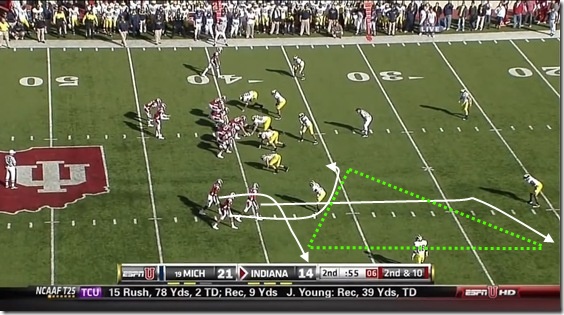
This is suicide. Purdue has seven defenders in the box, a strong safety overhanging on the strongside of the field, and a "deep" safety that's nine yards off the line of scrimmage. Instead of optioning to a passing play or simply heaving the ball up to Hemingway (top of the screen) who has single coverage against a guy who's 5'11", they stick with the original playcall and hand the ball off to Toussaint. The play ends as a loss of two yards because, well, duh.

I understand that Al Borges either doesn't like the bubble screen or has simply decided not to throw it, but at some point it's just willful ignorance. I mean:


OK, fine, maybe I'm just bashing my head against the wall, but this shouldn't happen. I don't care if you throw a quick hitch to either of the inside receivers here and let them turn it upfield. But allowing a defense to align like this without punishing them is not only doing a disservice to your offense, but it's flat out bad playcalling. Not calling a screen here is the worst thing Borges can do.

This leads to the bigger issue of making checks at the line. It's possible that in future years, with Shane Morris under center, the coaches will give the QB more opportunities to call audibles (which is typically the case in pro-style offenses, instead of the coach making the checks from the sideline in the spread), but this is a check that needs to be made right now. Either allow Denard to make checks at the line and call for screen passes when the defense is giving up 8 free yards or find a way to call in audibles from the sideline. This is officially my bugaboo of 2011. I hate this.

Al Borges reads SmartFootball. One of the most frustrating screen captures of the Greg Robinson years (for me anyway) came via SmartFootball during an explanation of attacking a two-deep formation with trips receivers. To wit:


The first time Michigan showed their three stacked receivers against Purdue, they ran exactly this play. Roundtree was the post route, Hemingway the hitch, and Grady the flat route. Denard threw the hitch route to Hemingway for a critical first down on Michigan's opening drive.

Michigan showed the same formation later in the game on a 3rd and 20 call and were able to pick up the first down because of a slight change in the routes.


Here, Purdue is in a cover-two shell with five underneath zone defenders and four down linemen who rush. Instead of Hemingway (the receiver in the middle) running a hitch route to the inside, he runs a 10-yard out route, creating a high-low decision for the safety:


These are the kinds of passing formations I like to see from Borges. Michigan floods the defensive zones and forces the safeties/corners to make a high-low decision. In very Michigan 2009 fashion, Purdue's safety bites on the Hemingway out route just long enough for Roundtree to get open on the corner route.

I suppose as long as Borges keeps bringing out play calls like this, I won't get totally annoyed with his lack of bubble screens. I guess...