Showing posts with label roy roundtree. Show all posts

Monday, November 19, 2012

A ray of hope


Iowa 17 - #21 Michigan 42
Melanie Maxwell | AnnArbor.com
I'm supposed to have something poetic to say about Denard Robinson, but Saturday's game left me cold. Denard lining up as a running back is not how this is supposed to go, not in college football where he turns dropped snaps into 43-yard touchdowns and made an entire fan base invent a whole new vocabulary to grapple with what he was doing on the field. For the last three years, Michigan fans have held their collective breath as Denard did whatever he could to get the ball 10 yards further toward the endzone. We usually exhaled pleasantly surprised.

The lasting image of Saturday's game for me, however, will be Fitz Toussaint's gruesome broken leg. In real time, there wasn't much to see but the slow-motion replay was one of those scenes they'll never show again and that I unfortunately saw before I could cover my eyes. Those are the kinds of injuries that end careers. For a player who has spent the last 11 games unsuccessfully fighting off tacklers in the backfield, in one of the first times all season he gets to the light of day and that happens. It all just seems unfair.

Toussaint has another season if he's able to recover, a luxury that's not afforded to Denard who lost his season to a similarly unfair albeit less horrifying injury. Denard's last game in the Big House felt like a dud though, and the heckling he'll get from Ohio State fans won't even be deserving of a his success. He'll be on the sideline rather than letting the "boos" rain down on him on the field. Denard Robinson's final game in a Michigan jersey will be in a half-filled stadium somewhere far away from Ann Arbor.

Of course Jordan Kovacs and Will Campbell and Roy Roundtree also touched the banner for their final time in maize and blue and unlike Denard, it's unlikely any of these guys will sniff the NFL. Were it not for Denard the last three years, this would probably go down as one of the most forgettable senior classes in Michigan history. Recruited by Rich Rodriguez, he specialized in finding the diamonds in the rough, of which none ever developed at Michigan. Three straight classes of pedestrian talent held together by Denard's heroics.

I think that's why Denard became so beloved. Put aside his smile or the fact that he's a talent that Michigan had never seen before. He was a ray of hope during the program's most devastating three years. Were it not for Denard, Michigan's abhorrent record during his tenure would have been even worse. There's a reason that there are multiple instances of Denard's first snap on YouTube with 60,000-plus views. He was Michigan football over the last year, both figuratively and literally.

With only two games left, Denard will be unceremoniously sent off to the NFL where his career will probably be a flash in the pan, not unlike his time at Michigan.

Monday, November 12, 2012

A forgotten classic


#24 Northwestern 31 - Michigan 38 (OT)
Melanie Maxwell | AnnArbor.com

Saturday's game will never go down as a classic. My freshman year of college, we had Braylon-fest, an improbable comeback against Michigan State. A few years later, Tate Forcier saw cover-zero and scampered 40 yards into the endzone before finding Greg Matthews on a circle route with 11 seconds left. The next two years, Denard Robinson broke Irish hearts in gif-able fashion. But these games are legendary as much because of the helmets that didn't have wings on them as the outcomes themselves.

The ending of Saturday's game was more improbable than any of those prior classics, but it will probably go forgotten. Beating Northwestern should be a certainty, not a cardiac event. Michigan's chances of playing for a Big Ten title this year are probably dead following yet another fortuitous (and incorrect) officiating call that went Nebraska's way. And this wasn't even a miraculous Denard Robinson performance during his senior season. This was a game that was uncomfortably close and probably ultimately meaningless.

Perhaps if I had been in the stadium, my impressions would change. By the time Michigan got the ball back with 18 seconds left, I was resigned to the team's fate: best case scenario was a long bomb followed by a coinflip field goal to tie the game because, let's be honest, Junior Hemingway ain't walking through that tunnel. But then a miraculous apparition appeared. Number 21 had the ball pinned to his shoulder, setting up the most vicious spiked ball in Michigan history. When overtime started, there was just a sense that Michigan would pull the game out. They had too much momentum, but more concretely, in overtime, always side with the team that has the 6'4" robobeast quarterback.

After Michigan scored in overtime and put the pressure on the Wildcat offense, the ensuing possession went about as well as you can hope for against an option team: 7 yard gain, 2 yard gain, 1 yard loss, 0 yard gain; game. Though Northwestern had been gashing the Wolverine defense on the speed option all day, they opted instead for a veer option. Jibreel Black beat a block, forced a cutback, and Kenny Demens treated Tyris Jones like an excited puppy jumping into its owner's arms after a month-long vacation.


This game was another good audition for Devin Gardner, but it highlighted something that appeared the week before. It seems like Al Borges treats Gardner differently, and not just in playcalling. Gardner gets to the line of scrimmage, surveys the field and calls audibles, and uses a hard count to draw the defense offsides. I refuse to believe that Michigan's three-year starter, senior quarterback can't make the same checks or keep the defense on its toes--it's possible, but seems unlikely--so the question becomes, why does Borges treat the two quarterbacks so differently?

Playing almost exclusively under center helps with a lot of these issues. Hard counts can be used under center more easily, but making checks at the line of scrimmage is something that we've seen Gardner do a few times in the last few weeks that Denard hasn't done once in two years. The other advantage of playing Gardner under center so frequently is getting the play in and lining up faster. With Denard in the game, Borges changes formations from I-formation sets featuring two tight ends and a fullback to shotgun looks with three and four wide receivers. That much rotation of personnel has resulted in a lot of wasted first-quarter timeouts when Denard is in the game. With Gardner playing, the offense just seems more complete, a function of Borges more than the anything the quarterbacks are doing.

Regardless of why the difference exists, it's a very real aspect of this offense now. The offense looks better under Gardner, which unfortunately just highlights how improperly Borges has been using Denard the last two years, but there's no need in fretting over that now. Next year looks a lot more encouraging after the last two weeks and Michigan is still technically in the running for the Big Ten Title this year. Go Minnesota. Go Iowa. Ugh.

Bullets
  • Michigan struggled on defense in this game for a number of different reasons. Jake Ryan and Frank Clark both lost contain frequently which gave Northwestern big gains on the ground. In addition, and I think Mattison figured this out before the fourth quarter, but Michigan was defending the speed option in an unsound manner. The playside linebacker was always playing the quarterback, forcing a pitch to the running back who had nothing but blockers in front of him. I think Mattison assumed his corners and safeties could get off of their blocks on the outside the help contain the rushing attack, but Michigan's corners aren't very good at doing this. By the fourth quarter, Michigan started forcing the runs back inside.
  • Michigan's third-down defensive struggles where a different matter. Mattison couldn't use his okie blitzes because Northwestern spreads the field too far. Instead, he drew up a strong safety blitz that was largely ineffective. I'll draw these up later this week, but Mattison finally figured out what the problem was: he kept bringing Jordan Kovacs on a safety blitz from Colter's frontside, allowing him to recognize the blitz and scramble around. The one time the blitz actually landed, it was because Mattison flipped the field and brought the blitz from Colter's blindside.
  • Kain Colter is slippery. Michigan had him in the backfield a few different times but was unable to bring him down. Will Campbell pushed beyond the line of scrimmage only to see Colter scamper around and one of Michigan's defensive ends dip inside, giving up the edge and a huge rushing lane. This was the least disciplined defensive performance from Michigan we've seen all year, helped along by perhaps the best running quarterback Michigan has played.
  • The interior of Michigan's offensive line is broken. At this point, you don't burn redshirts, but Michigan's offensive line may be the weakest unit on the entire team. This is also why Fitz Toussaint is broken. He won't break 100 yards per game once this season.
  • I'll have to rewatch the game, but the linebacker rotation confused me. Michigan gave a lot of time to James Ross and Joe Bolden. Then again, Ondre Pipkins saw significant snaps again (and was much improved), so it may be that the defensive staff is willing to rolling the dice during the game more frequently in order to get these younger players some meaningful snaps.
  • This was far and away Roy Roundtree's best game as a Wolverine in the last two years, and not just because of his miraculous, game-saving catch. He was getting separation, making shoestring catches, and showed a bit of open-field shiftiness.
  • Michigan's secondary is very not good. I really worry about next week's matchup. Despite the fact that Iowa is terrible, they may have a decent pocket passer. Thomas Gordon has looked a stepped behind whoever he's defending for the last few weeks and JT Floyd didn't do much to alleviate fears that he's still too slow to keep up with Big Ten receivers. 
  • Devin Funchess is tall, and thank god.
Next Week
Michigan takes on Iowa in a game that will be closer than it should be. Were it not for three Purdue turnovers, Iowa would have been summarily beaten. Purdue managed 490 yards, 8.0 YPA through the air, and 4.8 YPC on the ground. In contrast, Iowa had only 264 total yards, 5.3 YPA, and 2.4 YPC, and yet they only lost by 3 points. Michigan should win, but this game will expose the Wolverine secondary in a way that we haven't seen this season.

Tuesday, October 23, 2012

Running into a brick wall


I said in my game column yesterday that Michigan's offense was incoherent against MSU: they didn't test the Spartans' defense deep despite safeties playing 8 yards from the line of scrimmage and they didn't test the defense horizontally to put a strain on overly aggressive linebackers. The other problem was that Borges called running plays on 19 of Michigan's 26 first downs, including 9 of 11 in the first half. What you'll see below will not surprise you: MSU's safeties are less than 10 yards from the line of scrimmage on a 1st and 10 early in the game. Borges calls a running play, doesn't audible, and the results are exactly what you'd expect.

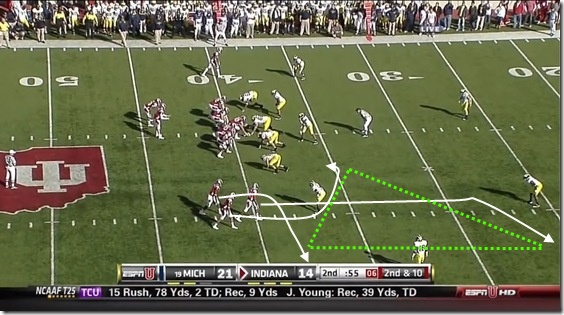
It's 1st and 10 early in the first quarter. There was absolutely no reason for MSU's safeties to be cheating as strongly as they are in this alignment other than Borges has obvious tendencies that can be exploited. As such, Michigan's three-wide, one-back set gets defended like this:


Jeremy Gallon begins to run across the formation on a jet sweep.


As the ball is snapped, look at the leverage of MSU's linebackers and safeties: all but one of them is on the balls of his toes and running toward the line of scrimmage.


By the time Gallon has passed Denard who will utilize Fitz Toussaint as a lead blocker, MSU's three linebackers are two yards from the line of scrimmage. Their two safeties are no more than six yards from the line of scrimmage.


One of MSU's linebackers is already beyond the LOS. Fitz Toussaint will block him as the lead blocker, leaving an MSU safety (highlighted) unblocked to hit Denard in the hole. Notice that both Denard and the safety are equidistant from the LOS.


Seeing an unblocked safety (highlighted) already at the line of scrimmage, Denard cuts back inside...


.... and is clobbered.


Video

The Takeaway
This is fucking infuriating. There was no doubt in the minds of MSU's linebackers or safeties; Michigan is running and there's no chance of Denard pulling up to throw here. Look, for example, at Gallon who is effectively running a wheel route. Who's covering him? Roy Roundtree runs into the screen to try and block anyone, but if he had run a route downfield, he would've had one-on-one coverage. For Borges, a guy who claims to want to attack vertically, this should be his bread and butter. Instead, it's a one-yard loss because he ran the ball on 73% of Michigan's first downs. This is untenable. If Michigan doesn't develop play action off of its base offensive sets or at least start breaking tendency, mounting a consistent offensive attack against good defenses will be impossible.

Thursday, October 11, 2012

Wide receiver blocking on jet sweep


I've been critical of some of Michigan's wide receivers' blocking this season, namely Devin Gardner and Jerald Robinson. Against Purdue, Al Borges called a play in which the wide receivers were doing something in the blocking game that Michigan State used to burn the Wolverines last year: seal the playside linebackers to the inside.

Michigan comes out in a three-WR set and will run a jet sweep for Jeremy Gallon (lined up in the slot at the top of the screen). Purdue counters with 3-4 front and three-high zone coverage.


As the ball is snapped, left guard Ricky Barnum will pull across the formation and run through the playside B gap looking for a Purdue defender downhill to block.


Rather than heading straight upfield to block the cornerback lined up over him, Devin Gardner (bottom of the screen) runs toward the middle of the field to block the playside ILB that is flowing down the line with Gallon. Toussaint will act as a lead blocker on the playside OLB and chip block him before heading upfield.


Toussaint engages (highlighted) and Gardner squares up his block. Notice Barnum still running upfield. His intended blocker is the free safety coming from the middle of the field:


The key to this play working is Toussaint making a good chip block before heading upfield. He hits the OLB with enough force to stop him from tackling Gallon in the backfield but is able to continue toward the cornerback. Barnum is still running toward the free safety.


Unfortunately, Gallon tries to bounce the play outside toward the sideline rather than cutting back inside where he had his blocking set up.


The play ends with Gallon being led out of bounds despite blocking set up to the inside.


Video

The Takeaway
It's pretty clear why MSU gashed Michigan with this last year. If Gallon cuts back to the inside, the only player with a chance of tackling him is the backside ILB (#39) who is doing a good job of flowing downhill with the play but probably has a 50/50 chance of actually making the tackle.

Borges has finally started to utilize bubble screens on a semi-regular basis, which is a great addition to Michgian's arsenal. Prior to using them, Michigan rarely tested a defense sideline-to-sideline. The only other plays the Wolverines ran that did so were these jet sweeps, which always seem, at best, moderately effective. Changing up a blocking scheme to seal the opponents playside linebackers and put a ball carrier in space against a single defender is all you can ask for. It will be interesting to see how this evolves throughout the season, but testing the outsides more frequently and effectively can only mean good things for this offense going forward.

Wednesday, September 19, 2012

QB Oh Noes: The Return (also, illegal man downfield)


Another fun trick that Al Borges brought back from the Rodriguez regime is the ever-deadly QB Oh Noes. Denard and Roy Roundtree rode this play to become one of the most dynamic QB-WR duos in the Big Ten in 2010. Once this was excised from the playbook, Roundtree's numbers fell off a cliff. So did Denard's, for what it's worth.

It's the first drive of the game and Michigan coems out in a two-TE set with two receivers split out to Denard's left. Fitz Toussaint is lined up in the backfield next to Denard.


As the ball is snapped, Michigan's two receivers as well as Devin Funchess (TE on the top of the screen) release. Denard immediately looks out to the nickelback lined up over Michigan's slot receiver. Toussaint will come across Denard's face for a handoff.


At this point, Denard sees what he wants: UMass' secondary hasn't moved and more importantly, the linebackers are staring into the backfield and ignoring Devin Funchess (arrow) who has a clear lane through the center of the field.


Denard is pulling back to throw to Funchess who is wide open. There's only one problem: Patrick Omameh (highlighted) who is an ineligible receiver, is already two yards beyond the line of scrimmage. This, as you might already know, is a penalty.


As Denard lets go of the ball, Omameh is already four yards downfield run blocking. This is still illegal.


Ball in the air, Omameh blocking downfield...


...touchdown. No flags. Wheeee.


Video

The Takeaway
This is super illegal. Michigan should have been flagged and the touchdown should have been taken away. If the UMass linebackers were keying on Michigan's guards for run/pass clues, having one of the guards release 5 yards downfield on the snap is a pretty clear sign that this is a running play. Look at the offensive line on the first QB Oh Noes of 2010:


The line of scrimmage here is the 31 yard line. The furthest any of Michigan's linemen get upfield before the throw is the 30 yard line. That's a tough call for the refs to make. Omameh scampering downfield is not.

The positive sign from this play, however, is that Borges appears to be learning how to use the threat of Denard's legs as a way to set up easy completions. The one tweak here is the use of Devin Funchess to catch the seam route rather than a slot receiver. One of the concerns with this personnel is that if Funchess can't develop into a reliable run-blocker, defenses will start keying in on him as a receiver and disregard the play action. But that's a worry for another time. Right now, Funchess is a problem for just about every defense and it's nice to see Borges utilizing his skillset.

Wednesday, August 22, 2012

What to expect: Wide Receivers 2012


Previously: Quarterbacks, Running Backs
Get it? Because they're all short.
Projected Starters: Jeremy Gallon, Roy Roundtree
Because much of the pre-season concern has been directed toward the defensive line and it's lack of proven contributors and depth, people have forgotten just how dire the wide receiver position is. Yes, Roy Roundtree had a great season in 2010 catching wide open passes that safeties gave up because of the threat of Denard's legs. Unfortunately, his hype came crashing back to the ground last year when he became That Dude That Lined Up Across From Junior Hemingway. After catching 72 passes for 935 yards in 2010, Roundtree caught only 19 passes (!!!!) for 355 yards last year. Great receivers find ways to get open and Roundtree just couldn't do that lsat year. An offense with Roundtree as the #1 receiver will have trouble in the passing game. His ceiling is Jason Avant, but I'm not sure that Roundtree has the athleticism to make the league.

You might remember Jeremy Gallon from his Houdini act against Notre Dame last year that set up the final touchdown pass to (hey!) Roundtree. Otherwise, Gallon was a nondescript slot receiver who ended up the second leading receiver on the team (31 receptions, 453 yards, 3 TDs).

The concern for this year is not that these guys can't catch. They're both sure-handed, underneath receivers with the ability to make defenders miss and gain yards after the catch. The problem is that Al Borges' offensive system emphasizes downfield routes and putting stress on a defense by stretching them vertically (maybe this will force Borges' hand with bubble screens). None of Michigan's returning receivers have the speed or size to scare any secondaries this year. The fear isn't that Denard will continue to heave balls into double coverage as Roundtree and Gallon get out-leapt and out-muscled for passes. It's watching these guys struggle to get separation from defensive backs and Denard being forced to make pin-point throws underneath, something he's capable of doing but not particularly consistently.

The Backups: Drew Dileo, Jeremy Jackson, Jerald Robinson
If you look at the names of the backups and think to yourself "Oh, those were all of the sleeper prospects that we haven't heard anything from the last few years" you're probably right, except for Wes Welker Drew Dileo. Dileo saw spot duty during Rodriguez's final year and caught a handful of balls last year. He's white and short, so people will naturally compare him to Wes Welker. Because that's reductive, suffice it to say that Dileo, though lacking in elite speed, has sure hands and can be relied on as a third-option. When Michigan has three- and four-wide sets on the field, Dileo will be out there. Otherwise, he'll probably spend most of his time on special teams.

Jeremy Jackson, son of running backs coach Fred Jackson, enters his third year as a slender (6'3", 204 lbs on the official site) outside receiver who has effectively zero on-field experience. Last year, Jackson caught only three balls during the season. He doesn't have top end speed or strength, but might be just tall enough to be a downfield threat. Jackson's development will go a long way toward this unit's effectiveness. If he proves to be contributor early in the season, that would give Michigan a legitimate outside threat with Roundtree and Gallon left to try and pick apart defenses underneath. This is a big "if" but there really aren't many other options.

The only others on the roster will be Jerald Robinson, a 6'1", 215 lbs redshirt sophomore who hasn't seen the field in his two years; true freshman Amara Darboh, a four-star outside type with offers from Florida, Michigan State, Nebraska, Wisconsin, and Notre Dame; and fellow true freshman Jehu Chesson who you can find out more about from MGoBlog. Long story short: Michigan's worst position on either side of the ball this year--barring tight ends, which will spend all season blocking and will be covered with the offensive linemen tomorrow--will be wide receiver.

The Possible Savior: Devin Gardner
If you don't recognize the picture on the right, chances are you follow recruiting less than I do, which, if you're reading this blog, is unlikely. That's Devin Gardner snagging a pass at a camp event during his senior year. He got so bored dominating everyone at quarterback, that he began taking reps as a wide receiver. Since Denard became a world-beater in 2010, the wheels in everyone's heads began turning.

After the spring game, the lack of viable receivers was one of the things that concerned me most about the offense. To wit:
Wide receiver. Holy smokes, Michigan desperately needs these. While most people are centering their concern on the offensive and defensive lines (and rightfully so, about which more later), wide receiver is nearly as barren as the linemen depth chart. If this game doesn't turn up the volume on the Gardner-to-WR chatter, nothing will. I didn't take note of everyone out there (did Roundtree even play in the game?), but regardless, Michigan has no one to catch passes that will threaten opposing defenses.
Michigan desperately needs to bolster its wide receiver corps and after yet another unremarkable year as a backup and lackluster spring game, Gardner-to-wide receiver only makes sense. With no chance that Shane Morris decommits from Michigan before the 2013 season, Hoke and Borges will finally have the pocket passer that they need to run their system. Gardner hasn't shown any signs of being the kind of quarterback that Borges needs: his mechanics seem beyond repair, his throws are inconsistent at best, and he still struggles to read defenses.

The reason to keep Gardner at QB rests on one question: If/when Denard gets injured will the team be noticeably better with Gardner under center than with Russell Bellomy? In my opinion, no. This is not to say that Bellomy is as good of a quarterback as Gardner, but if Denard goes down, this becomes Fitz Toussaint's team, regardless of who is taking snaps. Wasting Gardner's athleticism on the bench when Denard needs a legitimate deep threat to throw to is the kind of bet hedging that I don't expect Hoke to take part in.

Next year, this is Shane Morris' team. By that point, the roster will start to fill up with legitimate outside threats at wide receiver, at which point, you can move Gardner back to QB for depth. But this year, his talents are needed on the outside. I think the coaches are smart enough to realize this and won't waste Denard's final year with sub-par personnel.

Gardner spending the year at wide receiver (which I fully expect him to, FWIW) is the only hope for this offense to take any noticeable step forward. While Denard will show some natural progression during his second year in Borges' system, without adequate weapons, his performance will likely be stuck in neutral. Gardner can fill and possibly surpass the threat and production that Junior Hemingway brought last year.

Monday, April 16, 2012

2012 Spring Game thoughts


Angela J. Cesere | AnnArbor.com
I will try to have some more comprehensive thoughts once I can download a torrent of the game, but the spring game left a few impressions that I should probably write down.
  • Gardner. All the talk after the spring game focused on Devin Gardner's, shall we say, less that encouraging performance. After last year's spring game, I said...
    Devin, who has the size, still has little or no technique. Watching him fling a 40-yard pass from his off foot was the most Pryor-Armpunt thing I've ever seen him do. Unless the new staff can drastically improve his fundamentals, Gardner won't ever see significant playing time at Michigan, and that's disappointing.
    ...which is basically a carbon copy of what I'll say this year. Gardner's throwing motion is still unsustainable, which causes his accuracy to be inconsistent. He's not even reading the defenses particularly well. That interception: you can't make that throw. Gardner has done nothing to change my stance on his prospects: he will never see significant time at QB unless there's an injury. Next year, it's the Shane Morris Show.
  • Wide receiver. Holy smokes, Michigan desperately needs these. While most people are centering their concern on the offensive and defensive lines (and rightfully so, about which more later), wide receiver is nearly as barren as the linemen depth chart. If this game doesn't turn up the volume on the Gardner-to-WR chatter, nothing will. I didn't take note of everyone out there (did Roundtree even play in the game?), but regardless, Michigan has no one to catch passes that will threaten opposing defenses.
  • Offensive line. The first team offensive line looked fine, barring the two fumbled snaps, which are probably 50% on the quarterback, but beyond them, yikes. There is nothing there. If I can recall correctly, redshirt junior Erik Gunderson played a lot of right tackle in the game and reprised Mark Huyge's role in Spartans in the Backfield. Defensive linemen were routinely getting past the second unit, largely unabated. Pray for health because if not, this team is sunk.
  • Defensive line. Adequate. Totally adequate. Craig Roh looked good as the strongside end. Will Campbell was completely average. Otherwise, there was nothing particularly impressive or concerning about the defensive line. It won't be as good as last year, but it won't be a major liability this year (there's almost no way this prediction doesn't come back to bite me in the ass).
  • Secondary. The secondary looked pretty good actually. Greg Mattison seemed comfortable putting most of the secondary in man coverage throughout the spring game. Caveats about competition aside, the coverage down the field looked really solid, which will open things up for Mattison in the blitzing game.
  • Edge issues. The defense still showed some problems maintain edge responsibilities, which ugh, but fine. I'd like to see those things ironed out by now, but last year, the coaches recognize and addressed those issues quickly.
  • Bellomy. Russell Bellomy came in as the nominal #2 quarterback. Despite my desire to see Gardner move to wide receiver, I'm not sure I want Bellomy as Denard's backup. He showed good pocket presence and some ability to make plays, but he has a high school arm and only decent accuracy. He's not a quality backup yet.
  • Running backs. Thomas Rawls wins the annual Spring Game award for Most Impressive Player Likely to Spend the Season on the Bench. Rawls is a power runner that showed good vision and an ability to get upfield. This year still belongs to Fitz Toussaint, though. Rawls will be a good option when Toussaint needs a breather, but he doesn't offer much that Fitz doesn't already bring to the table. The biggest concern with Rawls isn't even about his play: I'm worried the coaches will try and revive the I-formation running game behind Rawls' shoulder pads. As we saw once again in the spring game, this team is ill-equipped to run from the I formation.

    In other running back news, Vincent Smith is still a better blocker than you. Hoorah for consistent third-down backs.
Overall, this was a pretty nothing performance. It's much more difficult to make broad, sweeping statements when the team isn't switching coaches or quarterbacks. The game probably induced more fears than it appeased concerns, but that's probably to be expected. In reality, it really just confirmed what we already knew: the defensive line will be functional, the offensive line is thin, Gardner isn't a quarterback, and the offense is going to rely far too heavily on Denard.

That's about all I can remember from a single viewing of the game. I don't know if I'm going to picture page anything from the game or not, but I might. Frankly, I don't remember seeing anything that was particularly noteworthy schematically, but if something caught your eye, let me know and I'll take a look. If other thoughts pop up throughout subsequent viewings, I'll try and bring them up.

Wednesday, November 2, 2011

Locking onto receivers: Purdue edition


Because it's tough to criticize a team after a 36-14 walloping of a conference opponent, this has turned into Point Out the Bad Decisions Our Quarterbacks Make Week. Yesterday, MGoBlog broke down Devin Gardner's horrible interception. Today, something from our starting quarterback: a missed touchdown pass to Kevin "Look How Open I Am" Koger.

It's the end of the first half and Michigan has put together a long drive. It's first and 10 from the 13 yard line and Michigan is in a traditional I-formation with two wide receivers and Koger lined up as a tight end.


As the ball is snapped, Hemingway and Roundtree both head downfield. Michigan is going to run a RB iso play action. Koger holds at the line of scrimmage for a moment before releasing downfield in a passing route.


A moment later, Denard is faking the handoff to Toussaint. Koger (mostly obscured by Lewan below) is releasing downfield. The safety at the top of the screen standing on the five yard line is assigned to Koger in man coverage.


This is the ARGH screenshot. The safety that was supposed to cover Koger is reading Denard's eyes. This is a textbook example of "looking off a safety". The safety sees Denard looking at Roundtree running a corner route and starts cheating that way. Koger is already wide open in the flat.


As Denard lets go of the ball, you can see how big of a mistake the pass is. Koger is wide open on the backside of the play without a defender between him and the endzone. Instead of throwing to Koger, Denard had made up his mind pre-snap to throw the ball to Roundtree.


But Roundtree is covered in the endzone. The Purdue cornerback breaks the pass up but probably should have intercepted it. Koger goes home and writes LiveJournal posts about being ignored.


This is something that we've seen from Denard already this year: he seems to make up his mind pre-snap when Michigan has single coverage on the outside. Though Koger is likely he's final read, Denard needs to recognize what defenders are assigned to each potential receiver. When Denard turns around after the play action, he has to recognize the deep safety assigned to Koger is reading his eyes and cheating toward Roundtree in the corner.

As was the case with Denard's interception early in the game, Purdue's defenders were reading his eyes, which always led them to the ball. Denard never goes through his reads and defenders are starting to key on that. This will be an issue as the season goes on. Unless he's able to progress through his reads and identify coverages, defenses will sell out on Denard's first read. This is why he throws into double coverage so frequently.

Tuesday, November 1, 2011

Offensive scheme and formation notes


After watching the Purdue game yesterday, I saw a lot of things from the Michigan offense to comment on but not necessarily all that many that deserved a dedicated post. The following are a few things the offense did that I took note of after watching the game.

The Pin and Pull. MGoBlog was happy to see that the pin and pull worked against Purdue. In reality, that's only half true: the pin and pull worked against Purdue when it was run from under center. Michigan first debuted the play against Eastern Michigan. At the time, I couldn't identify it as the pin and pull but I said this of the formation:
I don't understand why Michigan would run this blocking scheme instead of zone blocking the play. We already know that Molk is adept at reach blocking, so reaching and sealing defensive tackles will free Barnum to block EMU's linebackers. The same goes for Moore blocking on the edge; if Lewan and Moore double the playside defensive end and seal him to the outside quickly, Lewan will be able to release to the second level. However, with this pulling scheme, EMU stretches the play out to the boundary as Molk and Lewan attempt to pull into their gaps. This gives Eastern's pursuit defenders time to close off any cutback lanes.
The problem with the play has been that Denard is forced to wait for his offensive linemen to pull before he can head upfield. This stretches the play out and allows defenses to close off running lanes as Denard waits for his linemen. However, when the team runs it from under center, it gives the pulling linemen time to get into position because Denard has to hand the ball off. In addition, it forces the opposing linebackers to be cognizant of play action (even if it never works from under center). I'm officially in favor of the pin and pull as long as it's run from under center. The few times that Michigan did run it from the shotgun, Purdue was able to bottle it up.

Throw the ball fergodsakes. No seriously, throw the ball fergodsakes:


This is suicide. Purdue has seven defenders in the box, a strong safety overhanging on the strongside of the field, and a "deep" safety that's nine yards off the line of scrimmage. Instead of optioning to a passing play or simply heaving the ball up to Hemingway (top of the screen) who has single coverage against a guy who's 5'11", they stick with the original playcall and hand the ball off to Toussaint. The play ends as a loss of two yards because, well, duh.

I understand that Al Borges either doesn't like the bubble screen or has simply decided not to throw it, but at some point it's just willful ignorance. I mean:


OK, fine, maybe I'm just bashing my head against the wall, but this shouldn't happen. I don't care if you throw a quick hitch to either of the inside receivers here and let them turn it upfield. But allowing a defense to align like this without punishing them is not only doing a disservice to your offense, but it's flat out bad playcalling. Not calling a screen here is the worst thing Borges can do.

This leads to the bigger issue of making checks at the line. It's possible that in future years, with Shane Morris under center, the coaches will give the QB more opportunities to call audibles (which is typically the case in pro-style offenses, instead of the coach making the checks from the sideline in the spread), but this is a check that needs to be made right now. Either allow Denard to make checks at the line and call for screen passes when the defense is giving up 8 free yards or find a way to call in audibles from the sideline. This is officially my bugaboo of 2011. I hate this.

Al Borges reads SmartFootball. One of the most frustrating screen captures of the Greg Robinson years (for me anyway) came via SmartFootball during an explanation of attacking a two-deep formation with trips receivers. To wit:


The first time Michigan showed their three stacked receivers against Purdue, they ran exactly this play. Roundtree was the post route, Hemingway the hitch, and Grady the flat route. Denard threw the hitch route to Hemingway for a critical first down on Michigan's opening drive.

Michigan showed the same formation later in the game on a 3rd and 20 call and were able to pick up the first down because of a slight change in the routes.


Here, Purdue is in a cover-two shell with five underneath zone defenders and four down linemen who rush. Instead of Hemingway (the receiver in the middle) running a hitch route to the inside, he runs a 10-yard out route, creating a high-low decision for the safety:


These are the kinds of passing formations I like to see from Borges. Michigan floods the defensive zones and forces the safeties/corners to make a high-low decision. In very Michigan 2009 fashion, Purdue's safety bites on the Hemingway out route just long enough for Roundtree to get open on the corner route.

I suppose as long as Borges keeps bringing out play calls like this, I won't get totally annoyed with his lack of bubble screens. I guess...

Wednesday, October 26, 2011

Progress report: The 2011 offense


Since it's Michigan's bye week, it's a good time to take stock of where the team is currently in relation to where we expected them to be preseason. Previously: Where are they now: The team, the team, the team, The defense


Preseason expectation:
Matching the numbers from last year would be a near miracle and would make my season prediction the most off-base thing written all year. It's safe to say, however, that the offense, regardless of anything else, will revert back to the mean, if only slightly (best case scenario).

Despite my fear that this squad will look like the 2008 catastrophe, things are not really that dire. In reality, the offense will look more like the 2009 Forcier-led team: flashes of brilliance punctuating frustrating mistakes and crippling plays. If Denard can prove me wrong and become a consistent, accurate passer, this offense could really take off. Unfortunately, there's too much evidence to the contrary for me to buy into him as a quarterback that can lead a passing-oriented offense.
That is all depressingly, shockingly, [insert adverb here] correct. Michigan's offense this year has fluctuated between the Denard spread'n'shred that dominated opponents last year to a grab bag of unrelated plays that are neither surprising nor effective. A comparison between 2010 and 2011's numbers beckons:

Passing Rushing Scoring
2010 36th (250.15 YPG, 8.45 YPA) 13th (238.54 YPG,  5.58 YPC) 25th (32.77 PPG)
2011 81st (212.17 YPG, 8.90 YPA) 12th (239 YPG, 5.62 YPC) 28th (34.67 PPG)

It's not difficult to see what happened here. Despite the 2011 numbers being bolstered by a weak strength of schedule which will even out as the team heads deeper into Big Ten play, Michigan's passing game has fallen off a cliff. You don't need the numbers to tell you that though. This is largely due to Al Borges' pro-style passing attack that emphasizes deep, downfield throws rather than getting players into space (further evidence is the increase in YPA despite the drop in total passing yards). Borges has implemented the QB Oh Noes that accounted for a significant portion of Denard's passing last year, but this season, they've been more of the TE seam route variety than the hand-wavingly open slot receiver type we saw last season. Otherwise, Borges has called a lot of vertical routes that have ended in Denard throwing into double coverage or flat overthrowing receivers.

Those numbers are not quite as bad as I thought they'd be, however. Michigan's running game has remained mostly intact, while scoring is actually up slightly from last year. Again, as the team plays further into the Big Ten schedule, expect those numbers to drop, but they may not fall off too significantly. That's the hope, anyway. But on with the show...

Monday, October 3, 2011

Minnesota 2011: Where the playbook gets wonky


Minnesota 0 - #19 Michigan 58
One of the reasons Dave Brandon cites for hiring Brady Hoke was his defensive mindedness. He even referenced it when comparing Hoke to Bo Schembechler (!) during the Minnesota game. After the initial hire, I investigated the veracity of that rational:
Though Hoke has a reputation for being a defensive-minded guy--one of Dave Brandon's biggest selling points for him--Hoke's defenses have consistently hovered anywhere between middle-of-the-road and completely terrible. The early returns from his head coaching jaunts are understandably poor: he was taking over two historically bad programs and had lots of building to do. What's most disturbing is Ball State's continued incompetence even four and five years into Hoke's tenure...

The general takeaway here is that Hoke's defenses are not something to build your team on. Despite their ability to create turnovers (+17 in 2007!), his defenses do nothing exceptionally and, on average, are near the worst in the country. Any attempt to chalk this up to strong competition is easily dismissed when you look at their strength of schedule (which also hovered around the weakest in the country).
Arguments can be made that this is Greg Mattison's defense--which historically have been a significant upgrade from those that he inherited--rather than Hoke's, but regardless of who this can be attributed to, it's clear now that for the foreseeable future, the defense will be what this program intends to hang its hat on.

Caveats apply for this game: Minnesota truly is the worst team in the FBS. They were starting a freshman quarterback who was in over his head. And the skill position players lack the ever-important "skill" that is so preferable for that personnel. This was, however, the first shutout since the Carr years--even crash test dummies Delaware State were able to put points up against Rodriguez's defense. For all of the (mostly regrettable) This Is Michigan posturing, this game felt like a Michigan football game against a significantly inferior opponent: smothering defense that played near flawless football and executed exactly how they were supposed to.

There were no blown coverages that we look at on film and say "They'll get that ironed out during the season." There were no glaring weaknesses that could be exploited, either. Michigan put in their backup quarterback in the third quarter and found playing times for the likes of Richard Ash who, but all accounts, has no business being on the field this season. With Borges making the proper offensive adjustments and largely scrapping his traditional playbook to accommodate the skill set of Denard and Co., and the gawdawfulness of the Big Ten, forget anything I said preseason. Michigan's new ceiling should be recalibrated to account for the obvious upgrade on the coaching staff and their Little League schedule in the Big Ten. Michigan has a real chance to have a banner year this season.

Bullets
  • Al Borges ftw. The changes that he's made to his offense are nothing short of revelatory. It's clear that he understands offense, not just his offense. The way he tweaks his schemes (in this game, the use of the QB stretch counter, which I'll picture page this week) is the most clear indication that this coaching staff is not only intelligent but will be successful over the years. Borges has found the offense's strengths and opposing defenses' weaknesses and exploited them.
  • Greg Mattison makes me hate Rich Rodriguez. If only Rodriguez hadn't completely screwed up his defensive staff, this team could've been something really special this year. Though Borges is doing well with this offense, it's still a downgrade from Rodriguez's spread and shred. But Mattison has turned what appeared to be a bunch of underachievers into a really solid defense. Alas...
  • Denard looked much improved. His accuracy was certainly better in this game, which may have been a result of the operation he recently had on his throwing elbow. But it is also likely due to a tweaked offensive structure. We didn't see Denard taking shots downfield in this game, and most of his passes were short hitch routes and simple reads. We'll see if this is sustainable against a defense that isn't a smoldering crater.
  • Vincent Smith now has stats in the "Quarterbacks" column of the stats page. Borges had fun in this game.
  • Blake Countess might not be mirage. He appears to be a young cornerback that can, like, totally cover people. This is a good thing going forward.
  • Roy Roundtree is officially a non-factor in this offense. This doesn't really surprise me (he's not an outside receiver and he doesn't have the shake from the slot that some of the other guys do), but it is disappointing after his year last season.
Next week
Though Michigan nominally opened the Big Ten season against Minnesota, well, no. Next week's game against Northwestern will be the team's first real conference test. With ongoing injuries to Dan Persa, that game suddenly looks a lot more winnable.

Tuesday, September 27, 2011

Denard locking onto receivers


Ed. note: It's going to be a relatively slow week on the site this week. I have family in town and this game was never in doubt. Chances are there will only be one post a day this week. Some might come later than usual.

A lot has been made of Denard's regression in the passing game this year without many answers. His accuracy has always been a problem, but more disturbingly, Denard makes poor decisions, often throwing deep into double coverage. Jump balls have become a staple of the offense but they haven't been a particularly reliable option. One jump ball that Denard threw against San Diego State illustrates why his passing numbers may be so poor this season.

It's midway through the first quarter and Michigan just forced the first of Ronnie Hillman's fumbles. The offense comes out in a shotgun, three-wide, two-back set. The defense is in a 3-4 front wth man coverage.


On the snap, the defense rushes five with a stunt on the defensive line. Denard has man coverage on all the receivers with one "deep" safety (who is only six yards from the line of scrimmage).


A moment later, Denard has locked onto Roy Roundtree on the outside. My impression is that the coaches told Denard to take shots down the field. He was likely told that whenever he has one-on-one man coverage on the outside without safety help, that he should throw it up to that receiver. Here, Roundtree has single coverage on a fly route. On the other side of the field, Drew Dileo and Junior Hemingway are bother going to run hitch routes; Denard will never see these.


Hemingway and Dileo are breaking off their routes. The closest defender to either of them is five yards away. Roundtree, meanwhile, was jammed at the line of scrimmage and being pushed to the outside. Denard is about to throw to Roundtree who still hasn't beaten his defender.


As Denard lets the ball go, Roundtree is still below his defender. In addition, SDSU's safety is breaking on the pass, though he's too far from Roundtree to be a factor. Dileo and Hemingway are wide open.


This is a fundamental difference between Al Borges' and Rich Rodriguez's offense. In Rodriguez's option offense, the focus was always to pick up yards and stay ahead of the down and distance. Any time they did take a shot downfield, it was the QB Oh Noes that were wide open. In this pro style offense, the coaching staff expects Michigan's players to simply out perform the defense, rather than keeping them guessing with simple routes and reads that would produce 5-6 yard gains and possible yards after catch*.

There's nothing wrong with this style of offense if you have the players to do it (the Chad Hennes and Braylon Edwards of the world). Michigan. however, is loaded with players that aren't necessarily able to out perform their counterparts, rather, they're able to make something out of nothing. Denard needs to recognize the cushion that the weakside defenders are giving Dileo and Hemingway and pass on the single coverage against Roundtree, who isn't much of a leaper.

I'd have to go back and look at the other ill-advised jump balls that Denard has thrown this season, but this seems like it's probably indicative of the problem: Denard making up his mind before the ball is snapped and throwing even when his receiver can't get free. It'll be crucial for Denard to be more judicious in these situations if the team is going to sustain drives and if Denard is going to keep his numbers up.

*It would be difficult to track, but I would bet that a significantly higher percentage of Denard's passing yards last year came after the catch. This season, when he completes passes, they seem to be further downfield. This probably also explains his lower completion percentage.

Tuesday, September 13, 2011

Zone reading Manti Te'o


By my count, Michigan ran the zone read against Notre Dame three different times and miraculously, despite being forced to hand the ball off for the majority of last year, Denard was able to make the proper read and pull the ball himself. Al Borges accomplished this by reading the Notre Dame linebackers, specifically, Manti Te'o who is, by most accounts, Notre Dame's best defender. Even more impressively, Borges was able to attack Te'o on the zone read from an entirely different formation throughout the game. The second instance, shown here, was the most effective, netting 39 yards, but the shortest of the other option plays went for 13 yards.

Michigan comes out in a two tight end set with Mike Shaw in the backfield and Roundtree and Hemingway to Denard's left. Notre Dame is in a standard 4-3 alignment with the strongside linebacker, Prince Shembo, shaded over Roundtree in the slot.


As the ball is snapped, you can see the offensive line beginning to zone block to the right. Te'o, who Denard will read, is four yards beyond the line of scrimmage and directly above left guard Ricky Barnum.


As the mesh starts, Barnum is sliding right to double the nose tackle and Te'o steps up to attack the strongside B gap that was vacated by Barnum. Denard will read whether or not Te'o attacks that hole or if he stays home.


Denard and Shaw are still engaged at the mesh point right now, and Te'o is committing to the handoff.


By the time Te'o realizes that Shaw doesn't have the ball, he's already been sucked into the offensive line. Koger was lined up as the strongside tight end and has leaked out to kick block Notre Dame's strongside linebacker. Roundtree is releasing from his slot receiver position to head upfield and block the Notre Dame safety at the top of the screen.


Video:


This play would go for 39 yards and stand as Denard's longest run of the day. Fundamentally, there's nothing spectacular about this play; it's a simple zone read. What Borges did here, however, was isolate Notre Dame's best defender and force him to make a decision and, more importantly, take himself out of the play.

What's brilliant about this play is that a linebacker won't be able to recognize whether or not he's being "blocked", so he will naturally attack what his eyes see. In this instance, he saw an offensive line that was zone blocking right, no unblocked defensive ends, and a mesh point between Denard and Shaw. This looked like a simple sweep play, but it was actually an option. This baited Te'o into committing to the Shaw handoff and left the weakside of the play wide open.